
Condition
Sacroiliac Joint Dysfunction
When SI joint pain makes sitting, standing and walking hurt, a physician-led regenerative approach may help reduce pain and restore comfort — without surgery.

When SI joint pain follows you through the day
Sacroiliac joint pain has a way of touching everything. It’s the deep ache low in your back or buttock when you stand up from a chair, the discomfort that builds on a long drive, the stab when you climb stairs or shift your weight onto one leg. Because that pain can mimic a disc problem, hip trouble or general lower-back strain, many people spend a long time — and try many things — before anyone names the SI joint as the source.
The sacroiliac (SI) joints connect the spine to the pelvis. When they become inflamed or unstable, they can cause lower-back and hip pain that’s often mistaken for other conditions. Getting the diagnosis right is the first, most important step — and that’s exactly where a physician-led evaluation earns its keep.
A non-surgical, regenerative approach that may help
Once the SI joint is identified as the source of your pain, our focus is on helping you feel better without jumping to invasive procedures. Regenerative options such as stem cell joint regeneration and PRP joint treatment use regenerative biologics (your own PRP plus donor-derived stem cells), delivered into or around the SI joint in-office, to support natural repair and help reduce pain.
This is not a cure, and results vary from person to person — but for the right candidate it can be a meaningful, non-surgical way to improve comfort and function. Whether it fits your situation depends on your evaluation.
Why patients choose Utah Stem Cells
- Physician-led, every time. Your evaluation and procedure are performed by Dr. William Cimikoski — not handed off to a technician.
- Careful, honest assessment. Because SI joint pain is so often misdiagnosed, we take the time to evaluate properly and tell you the truth about your options.
- Regenerative biologics. Treatment combines PRP from your own blood with donor-derived umbilical and amniotic stem cells.
- One clinic in Sandy. Evaluation, treatment and follow-up in a single, physician-owned clinic in the Salt Lake Valley.
What to expect
Every plan begins with a physician evaluation. Dr. Cimikoski assesses the SI joint, reviews your symptoms and history, and confirms whether you’re a candidate and which approach fits your goals. If treatment makes sense, it’s performed in-office and most patients return to normal activities quickly. Any improvement tends to develop gradually over the following weeks, and your provider will give you clear, realistic expectations — never a promise of a particular result.
This page is for general education. It is not medical advice and is not a promise of any particular result. Treatment suitability is determined by the physician based on individual evaluation.
How we can help
Treatments for this condition
Stem Cell Joint Regeneration
A non-surgical treatment for major joints that uses regenerative components to reduce pain and restore mobility — no surgery, minimal downtime.
Learn more →Platelet-Rich Plasma (PRP) Joint Treatment
A concentrated preparation from your own blood, injected into a joint to support natural repair.
Learn more →Not sure where to start? Talk it through with a physician.
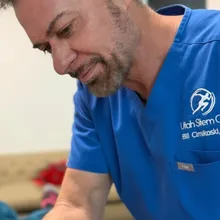
Physician-led care
Your care is led by Dr. William Cimikoski
At Utah Stem Cells, your evaluation and care are guided by our Medical Director, Dr. William Cimikoski — so you get honest, physician-led guidance about your options from the first consultation onward.
Meet Dr. CimikoskiFAQ
Frequently asked questions
What is sacroiliac (SI) joint dysfunction?
Your two sacroiliac joints connect the base of your spine (the sacrum) to your pelvis. When these joints become inflamed, irritated or unstable, they can cause pain — a condition known as SI joint dysfunction. It often produces lower-back, buttock and hip discomfort, and because that pain can mimic other conditions, it's frequently misdiagnosed.
What does SI joint pain usually feel like?
Many people describe a deep ache low on one side of the back or in the buttock, sometimes radiating into the hip or upper thigh. It often worsens with sitting for long periods, standing up, climbing stairs, or shifting weight onto one leg. Symptoms vary, which is one reason a proper physician evaluation matters.
How might a regenerative approach help my SI joint?
Regenerative options such as stem cell joint regeneration and PRP use regenerative biologics (your own PRP plus donor-derived stem cells), delivered into or around the SI joint in-office, to support natural repair and help reduce pain. For the right candidate it can be a non-surgical way to improve comfort and function. The physician confirms whether it's appropriate for you.
Is this non-surgical?
Yes. Our regenerative options are minimally invasive, in-office procedures — an approach many patients want to explore before considering more invasive interventions. Whether it's suitable for your SI joint is determined during a physician evaluation.
Can regenerative treatment cure SI joint dysfunction?
No. It's not a cure and not a guarantee. The goal is to help reduce pain and improve how the joint functions, and results vary from person to person. The physician will set honest, realistic expectations for your specific situation.
What is recovery like?
Because the procedure is minimally invasive and performed in-office, most patients return to everyday activities quickly. Any improvement tends to develop gradually over the following weeks as your body responds. Your provider will explain what to expect and how to care for the area afterward.
How is Utah Stem Cells different?
Every evaluation and procedure is physician-led by Dr. William Cimikoski — not delegated to a technician — and grounded in honest, evidence-informed guidance. Because SI joint pain is so often misdiagnosed, that careful, physician-first evaluation matters. If you're not a good candidate, we'll tell you.
How do I get started?
Book a no-pressure consultation. The physician will assess your SI joint, review your symptoms and history, and tell you whether a non-surgical regenerative approach is right for you.