
Stem Cells for Knee Pain: Can You Avoid Knee Replacement?
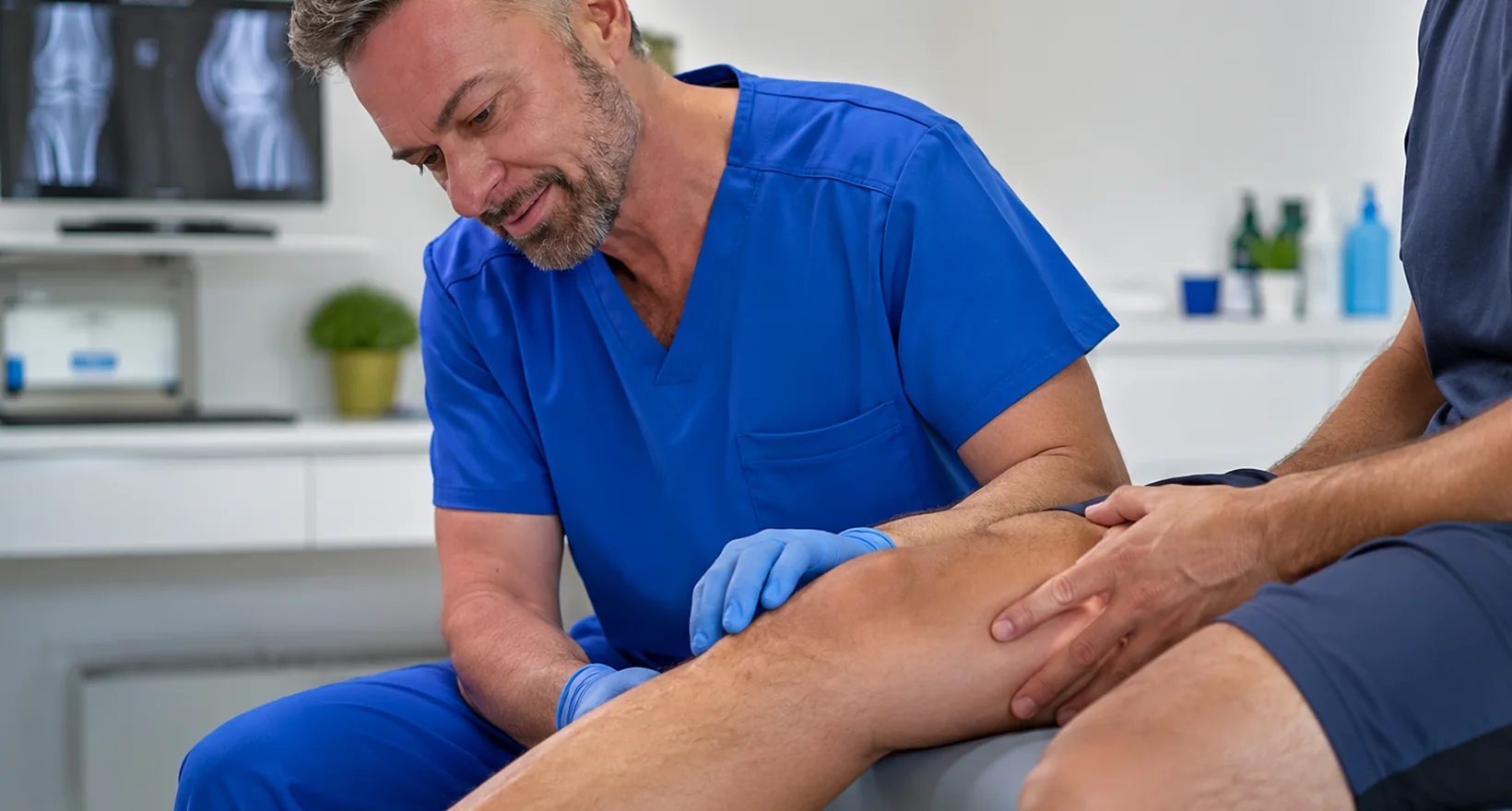
If knee pain is starting to decide what you can and can’t do — the stairs you avoid, the walks you cut short, the workouts you’ve quietly given up — you may already have heard the words “knee replacement.” For many people, that feels like a big, one-way step. So it’s natural to ask: are stem cells for knee pain a real alternative, and could they help you avoid knee replacement surgery?
This guide gives you an honest answer — what regenerative treatment can and can’t do, who it tends to help, and how to find out whether it’s a sensible option for your knee.
When knee pain leads to talk of surgery
Most chronic knee pain traces back to the joint gradually wearing down. As the smooth cartilage that cushions the knee thins, bone starts to rub against bone, and you feel it as pain, stiffness and swelling — the hallmarks of knee osteoarthritis. It’s the same process behind osteoarthritis in other joints.
When pain becomes constant and daily life is affected, surgeons often raise the option of a total knee replacement. It can be the right choice for severe, bone-on-bone arthritis. But it’s a major operation with anesthesia, hospital time and weeks — sometimes months — of rehab. Understandably, many people want to know if there’s a less invasive step to try first.
What “stem cells for knee pain” actually means
Stem cell therapy for the knee is a non-surgical, regenerative approach. Instead of replacing the joint, the goal is to support the body’s own repair environment — helping to calm inflammation and ease pain so the knee moves more comfortably. At Utah Stem Cells this is delivered as stem cell joint regeneration, a physician-performed, in-office procedure.
It’s worth being clear about where the biologics come from, because clinics differ:
- The stem cells we use are derived from ethically donated umbilical cord and amniotic tissue — prepared in a laboratory, not harvested from your body. We do not use autologous (your-own) stem cells such as fat- or bone-marrow-derived cells.
- PRP (platelet-rich plasma) is drawn from a small sample of your own blood and concentrated for its growth factors. It is often used alongside stem cells — you can read more on our PRP joint treatment page.
Can stem cells help you avoid knee replacement?
Here’s the honest answer: for some people, yes — and for others, no. Regenerative treatment is not a guaranteed way to avoid surgery, and it is not a cure for arthritis.
Where it tends to be most worth considering is mild to moderate knee osteoarthritis — knees that are painful and stiff but still have some cartilage to work with. In these cases, the aim is to reduce pain and improve function enough that you can stay active and, potentially, delay or avoid a replacement. Many patients explore it precisely because they’d rather not rush into surgery.
Where it’s less likely to help is severe, end-stage arthritis — a knee that is truly bone-on-bone with significant deformity. In those situations, a joint replacement may still be the more appropriate path, and a good physician will tell you so.
That’s why candidacy matters more than marketing. The only way to know which group you’re in is a proper evaluation — imaging, history and an honest conversation about what’s realistic for your knee.
What the research suggests
Interest in regenerative options for the knee has grown quickly, and the science is still evolving. If you like to dig into the evidence, we’ve summarized some of it in Stem Cell Research on Knee Osteoarthritis, and we walk through the practical upsides in Benefits Of Stem Cell Therapy For Knees.
The responsible takeaway is this: research points to genuine promise for symptom relief in the right patients, but these treatments are not an FDA-approved cure, results vary from person to person, and no reputable provider should promise you’ll never need surgery. Setting expectations honestly is part of good care — something we cover more broadly in 5 Benefits of Stem Cell Therapy.
Stem cells, PRP, or both?
These are related but different tools. PRP concentrates the growth factors already in your blood to support healing. Stem cells add regenerative signaling from donated birth tissue. Depending on your knee and your goals, the physician may recommend one or a combination — and in some cases a different regenerative approach such as prolotherapy may come up in the conversation. The right mix is an individual decision, not a fixed package.
Who is a good candidate?
You may be a reasonable candidate if you:
- Have mild to moderate knee osteoarthritis or ongoing joint pain
- Want to reduce pain and stay active without jumping straight to surgery
- Are in generally good health and have realistic expectations
- Understand this is about improving comfort and function, not regrowing a brand-new knee
You may not be a good fit if you have severe bone-on-bone arthritis, significant joint deformity, active infection, or certain other medical conditions — which is exactly what the evaluation is designed to sort out.
What to expect at Utah Stem Cells
Every plan begins with a physician evaluation. Your knee is examined, your imaging and history are reviewed, and Dr. William Cimikoski confirms whether you’re a good candidate — or tells you honestly if you’re not. If you proceed, the treatment is performed in-office, and most patients return to everyday activities quickly. From there, improvement tends to develop gradually over the following weeks as your body responds.
The point isn’t to sell you a procedure. It’s to give you a clear-eyed sense of whether a non-surgical option is worth trying before you commit to the operating room.
Frequently asked questions
Can stem cells really let me avoid knee replacement?
For some patients with mild to moderate arthritis, regenerative treatment may reduce pain and improve function enough to delay or avoid surgery. It is not guaranteed, and severe bone-on-bone knees may still need replacement. A physician evaluation is the only way to know.
Do stem cells regrow knee cartilage?
This is not a cartilage-regrowing “cure.” The goal is to support the joint environment, calm inflammation and improve comfort and function. Any provider promising to rebuild a new joint is overstating what these treatments do.
Is the procedure painful, and is there downtime?
It’s a minimally invasive, in-office procedure that most patients tolerate well, with little to no downtime. Your provider explains exactly what to expect and how to care for the knee afterward.
How soon might I notice a difference?
Regenerative approaches work gradually as your body responds over the following weeks. Timelines and results vary from person to person, which is why the physician sets realistic expectations for your situation.
How do I find out if I’m a candidate?
Book a no-pressure consultation. We’ll review your imaging and history, examine the knee, and give you an honest recommendation — including whether surgery would actually serve you better.
This article is for general education. It is not medical advice and is not a promise of any particular result. Stem cell therapy is not an FDA-approved cure for arthritis, and treatment suitability is determined by the physician based on individual evaluation.