Shoulder Pain That Won't Go Away? Regenerative Medicine May Help
You’ve rested it. You’ve iced it. Maybe you’ve done physical therapy, taken anti-inflammatories, even had a cortisone shot. And yet the ache in your shoulder is still there — catching when you reach overhead, waking you at night, quietly shrinking what you’re willing to do. When shoulder pain drags on for months, it’s fair to ask whether there’s an option beyond “wait and see” or “eventually, surgery.”
For some people, regenerative medicine is that middle path worth understanding.
Why shoulder pain lingers
The shoulder is the most mobile joint in the body, which also makes it one of the easiest to irritate. Persistent pain often traces back to:
- Rotator cuff wear or tears — the tendons and muscles that stabilize the joint
- Tendinitis and bursitis — inflammation from overuse or repetitive motion
- Osteoarthritis — gradual cartilage wear, the same process behind osteoarthritis elsewhere
- Old injuries that never fully settled
The common thread is that these are soft-tissue and joint problems that don’t always heal well on their own — which is why pain can linger long after you expected it to fade.
When the usual options aren’t enough
Rest, anti-inflammatories, physical therapy and cortisone injections all have their place. But they mostly work by calming symptoms — they don’t set out to support the underlying repair. That’s why relief can be temporary, and why so many people cycle through the same treatments without lasting progress.
At that point the conversation often jumps straight to surgery. For some shoulders that’s the right answer. For many, though, it’s worth exploring a less invasive step first.
How regenerative medicine approaches shoulder pain
Regenerative medicine takes a different angle: instead of only masking pain, the goal is to support your body’s natural repair processes in the irritated tendon or joint. At Utah Stem Cells this is delivered as stem cell joint regeneration and PRP joint treatment — physician-performed, in-office, and designed to work with the shoulder you already have rather than replacing it.
The aim is to help calm inflammation and support healing so the shoulder moves more comfortably — with minimal downtime.
PRP, stem cells, or both?
These are two different regenerative tools, and it’s worth knowing which is which:
- PRP (platelet-rich plasma) is drawn from a small sample of your own blood, concentrated for its growth factors, and injected into the shoulder.
- Stem cell therapy adds regenerative signaling from ethically donated umbilical cord and amniotic tissue — prepared in a lab, not harvested from your body. We do not use autologous (your-own) stem cells such as fat- or bone-marrow-derived cells.
Depending on your shoulder, the physician may recommend one or a combination. We break the comparison down fully in PRP vs Stem Cells: Which Treatment Is Right for Your Joint Pain? — a helpful read if you’re weighing your options.
Who might it help — and who might not?
Regenerative approaches tend to be most worth considering for mild to moderate shoulder problems: nagging tendinitis, early rotator cuff wear, or ongoing joint pain that hasn’t responded to conservative care. Good candidates are generally in reasonable health and have realistic expectations — the goal is to reduce pain and improve function, not to guarantee a brand-new shoulder.
It’s less likely to be the answer for a large, full-thickness rotator cuff tear or a severely degenerated joint, where a surgical repair may be more appropriate. The honest way to find out which group you’re in is a proper evaluation — and a provider willing to tell you when surgery would actually serve you better. The same principle applies across joints, as we discuss in Stem Cells for Knee Pain: Can You Avoid Knee Replacement?
If you’d like a broader sense of what regenerative medicine can address, 10 Conditions That Can Be Treated with Regenerative Medicine is a good overview, and Benefits Of Stem Cell Therapy For Knees walks through the practical upsides in a related joint. In some cases a different regenerative approach such as prolotherapy may also come up.
What to expect at Utah Stem Cells
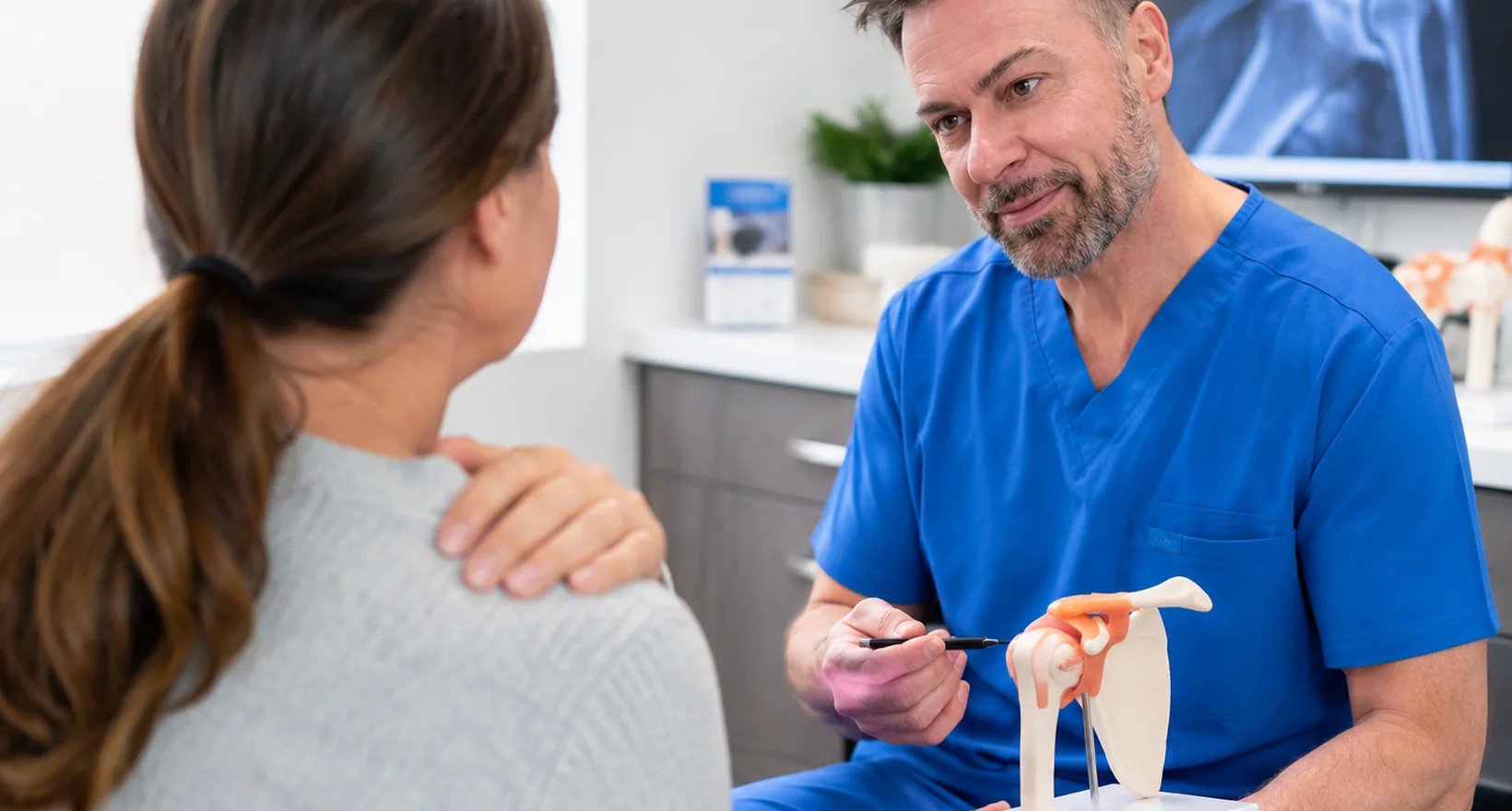
Every plan starts with a physician evaluation. Dr. William Cimikoski examines the shoulder, reviews your imaging and history, and confirms whether you’re a good candidate — or tells you honestly if you’re not. If you proceed, treatment is performed in-office, most patients return to everyday activities quickly, and improvement tends to develop gradually over the following weeks as your body responds.
The goal isn’t to push a procedure. It’s to give you a clear, honest picture of whether a non-surgical option is worth trying before you commit to the operating room.
Frequently asked questions
Can regenerative medicine fix a rotator cuff tear?
It may help with mild wear or partial irritation by supporting natural repair, but it is not a substitute for surgery in the case of a large, full-thickness tear. A physician evaluation — including imaging — is the way to know which applies to you.
Are the stem cells taken from my own body?
No. At Utah Stem Cells the stem cells come from ethically donated umbilical cord and amniotic tissue, prepared in a laboratory. Only PRP is drawn from you, from a small blood sample. We do not use fat- or bone-marrow-derived (autologous) stem cells.
Is it painful, and is there downtime?
Treatment is minimally invasive and performed in-office. Most patients tolerate it well with little to no downtime. Your provider explains exactly what to expect and how to care for the shoulder afterward.
How soon might I feel a difference?
Regenerative approaches work gradually as your body responds over the following weeks. Timelines and results vary from person to person, which is why the physician sets realistic expectations for your situation.
How do I find out if I’m a candidate?
Book a no-pressure consultation. We’ll examine the shoulder, review your imaging and history, and give you an honest recommendation — including whether another approach would serve you better.
This article is for general education. It is not medical advice and is not a promise of any particular result. Regenerative treatments are not FDA-approved cures, and suitability is determined by the physician based on individual evaluation.